
In this blog post we tackle one of the most common criticisms we receive, i.e., the perceived irreconcilability between computerized algorithms and the human creative process.
Hitherto, the filmed entertainment business is sceptical at the idea of having a script analyzed by a computer, stating that an automated process cannot grasp something as fundamentally human as a story. To many of them, the concept of having their work appraised by a machine instead of a person is almost offensive. The criticism then goes on: if algorithms get to decide which screenplays will be produced — assuming that the above criticism is correct — then artificial intelligence is fundamentally unable to spot diamonds in the rough. This concern is understandable and essentially boils down to the question: to what extent is an A.I. capable of casting judgment upon human creative works?
At ScriptBook we acknowledge that computers are unable to experience an emotional response when analyzing a script. That being said, what we can do is detect the underlying patterns that elicit such emotional responses and ultimately, predict them despite a machine’s lack of emotions. If anything, the recent successes of deep learning in various domains such as image recognition, machine translation, etc., provide strong arguments for this point of view. Take for example image recognition [1, 2, 3, 4]. Here, a neural network receives a flat, two-dimensional array of pixel values that encode an image of a certain object. The neural network needs to decide which of thousands of possible categories of objects is the correct one. We as humans are able to interpret a picture in the context of the real world; we know how to conceptualize it in three dimensions, we understand the connection between form and function and we can perceive motion behind a still picture.
Neural networks and other algorithmic forms of intelligence have access to none of this information, and yet they match, if not surpass, human performance in visual tasks. What they lack in contextual information, they more than make up for in the sheer volume of data they can internalize when they are trained. This ability has already been able to beat humans in some very “human” domains. Consider for example last year’s DeepStack AI beating humans at the decidedly human game of poker [5]. This was an absolute breakthrough, because poker is a so-called “imperfect information game” where human intuition and psychology play decisive roles, two properties not commonly associated with computers.
But, what about storytelling?
The advantage of big data is a formidable one. While a computer may not be able to capture why we find a certain movie enthralling, it can compare the script of said movie to a very large dataset of other scripts and draw parallels to story structures in past movies that have been associated with successes or failures. While we have no doubt that a human reader will beat a computer in understanding the subtleties of an individual script, it would be very hard, if not impossible for humans, to compare that script against tens of thousands of others. It would be equally hard to correlate the content of all those scripts to financial and critical success in an objective manner, but this is something machines excel at. A reader will use the human approach; a combination of experience and subjective gut feeling. Gut feeling is not necessarily a bad predictor, of course, but it certainly is a very biased one (cf. our previous blog post on gender bias).
As for the matter of originality, stories have been with our species from the very beginning, and the questions of how and why they work has been studied for countless years. What these studies reveal (see [6] for a comprehensive overview) is that stories that stand the test of time tend to share common structural elements. Furthermore, as explored by Georges Polti in his work “The Thirty Six Dramatic Situations” as early as 1895 [7], all dramatic situations in each and every story can be brought back to a prototype out of a list of 36 distinct situations.
Even original stories seldom deviate too strongly from this common core. Structure and story are inextricably linked, and structure can be learned by an A.I.
Use case: Get Out (2017)
As an example of a highly original screenplay that follows typical story structure, consider 2018’s “Best Original Screenplay” Oscar-winner “Get Out”. The movie opens with an inciting incident which sets up a mystery to be solved. After this, during the first act, we get to know the main protagonists and learn the rules of the environment in which the story takes place. During the second act, things start to unravel. The main protagonist, and through him the audience, starts to understand that not everything is what it seems to be. At the movie’s midpoint, the protagonist gets an unexpected warning to ‘get out!’, a breakpoint after which he will no longer react to his environment, but start acting. During the third act, our protagonist gets into more and more trouble, ultimately hitting a desperate low point at which all seems lost, after which he nevertheless manages to turn the tables around and come out safe and sound. This is textbook. What makes it so original are the setting and the details, not the structure.
One of the in-house developed metrics that we predict for a movie script is called “artisticness”. This is a metric that we use to differentiate between movies targeting as large an audience as possible (e.g., blockbusters) and movies that are expected to appeal to a more niche audience (e.g., arthouse).
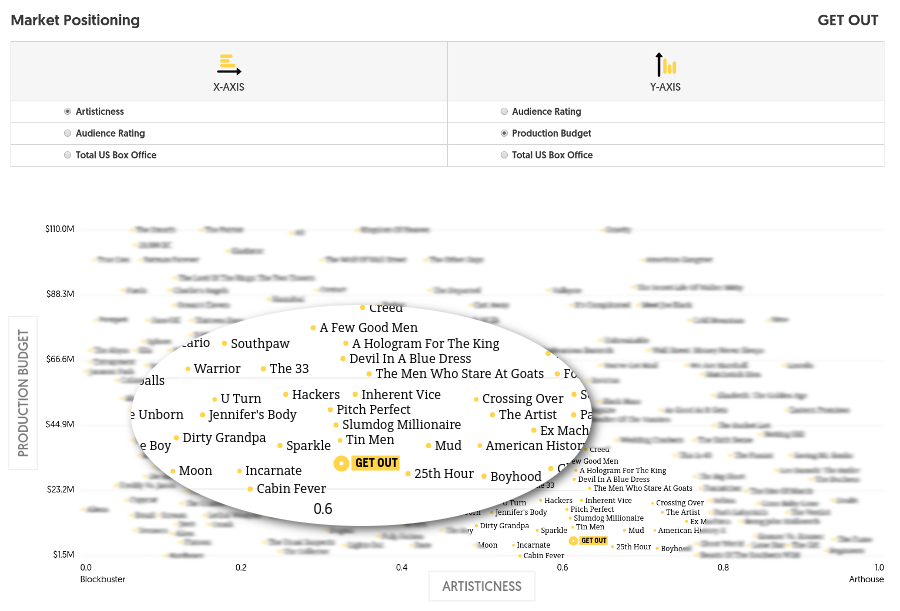
When parsing the script for “Get Out” with our AI and plotting production budget vs. artisticness, as depicted in Figure 1, we see that our system places “Get Out” slightly more towards the “arthouse” side of the scale. Note that the production budget for “Get Out” is our predicted value (real: $5M, predicted: $6.5M).
The graph further tells you that for a similar production budget, 2009’s “Moon” has a slightly broader appeal, whilst 2014’s “Boyhood” is aimed at a more select audience. Analogously, “The Men Who Stare At Goats” targets a similar audience according to this scale, but has benefited from a significantly bigger production budget.
Use case: A Most Violent Year (2014)
Another interesting case is 2014’s critically acclaimed “A Most Violent Year”. This time, instead of plotting production budget to artisticness, we compare our predicted audience (IMDB) rating (real: 7.0, predicted: 7.1). The result is depicted in Figure 2.
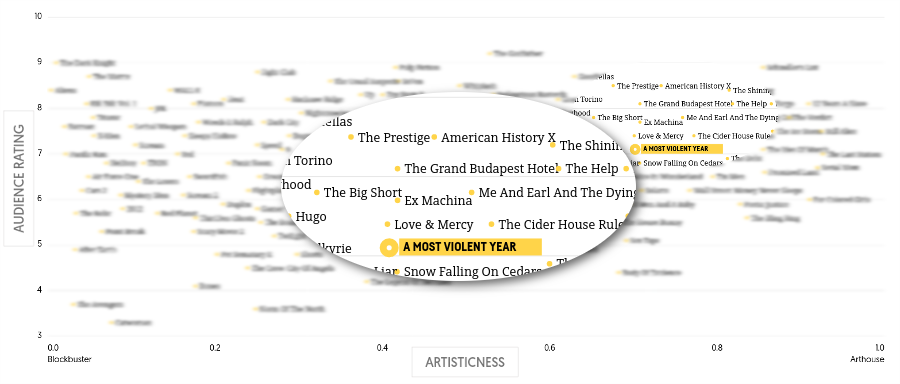
We see that our AI manages, based solely on the script, to recognize that “A Most Violent Year” is definitely more akin to movies such as “Ex Machina” and “The Grand Budapest Hotel” than either “The Dark Knight” or “The Last Station”. It is clear that comparing “A Most Violent Year” to “The Dark Knight” would not make that much sense as both are movies with clearly different appeals. To a human this is obvious; not so to a computer. Nevertheless, our AI has learned to make this differentiation.
This means that despite not being able to be emotionally triggered, our AI is capable of firstly learning a scale that makes sense on a human, intuitive level, and secondly positioning a script on this scale in the vicinity of movies that make sense, once again, on an intuitive level. It does this despite having no notion of what “originality” is, but instead by analyzing structural elements of the story.
Conclusion
As indicated above, creativity tends to follow structure. At ScriptBook, we do not try to emulate a reader. Rather, we extract the defining elements of a story (characters, structure, dialogue style, interactions, dramatic events…) and represent them in the form of numbers. Is ScriptBook free of error? No, but then again, nor are humans. The kinds of mistakes ScriptBook makes are fundamentally different from those that a human being makes, not based on gut but on learned patterns. If anything, this makes it perfectly complementary to human intuition.
References
- EE Times article on image recognition
- Kaiming He, Xiangyu Zhang, Shaoqing Ren, Jian Sun; “Delving Deep into Rectifiers: Surpassing Human-Level Performance on ImageNet Classification”, IEEE International Conference on Computer Vision (ICCV), 2015, pp. 1026–1034; arXiv:1502.01852
- Florian Schroff, Dmitry Kalenichenko, James Philbin; “FaceNet: A Unified Embedding for Face Recognition and Clustering”, IEEE Conference on Computer Vision and Pattern Recognition (CVPR), 2015, pp. 815–823; arXiv:1503.03832
- Miguel P. Eckstein, Kathryn Koehler, Lauren E. Welbourne, Emre Akbas; “Humans, but Not Deep Neural Networks, Often Miss Giant Targets in Scenes”, Current Biology Vol. 27, Issue 18, 2017, pp. 2827–2832.
- Moravčík, Matej et al.; “DeepStack: Expert-Level Artificial Intelligence in No-Limit Poker”, Science, 356, 2017.
- John Yorke; “Into the Woods: How Stories Work and Why We Tell Them”, Penguin, 2014.
- Georges Polti; “Les 36 situations dramatiques”, Paris, Mercure de France, 1895; 1921 English translation available free of charge online at archive.org.