The (lack of) prevalence of women on the film set has been a topic of much debate. While the movie business has been making progress in the right direction on this account, true gender equality is still some way off. The most recent episode in this discussion involves a study by Creative Artist Agency (CAA) and shift7 [1], which claims to observe some interesting parallels between a movie’s lead gender and its success at the box office. “Films with female stars earn more at the box office” [2], “Movies Starring Women Outperform Male-Led Titles at Box Office, Study Finds” [3] and “Movies Starring Women Make More Money At The Box Office, Study Finds” [4] are just some of the headliners that have spawned in this study’s wake.
At ScriptBook, we were somewhat intrigued by the strong claims these articles make, having never made a similar observation ourselves. Since we have access to similar data, we decided to dig deeper into the matter, and replicate the study.
This blog post reports our findings concerning the casting of females in movies. In the first part we will describe our data set and how we acquired labels. Next, we will discuss the differences in box office earnings between male and female leads, and between movies that pass and fail the Bechdel test. In the last section, we look at the presence of women in movies and how it has been evolving through the years.
The Data
In our study, we considered a dataset containing movies released between 2014 and 2017 (inclusive). This is the same time window that the CAA / shift7 study employs, and ensures that only recent trends are observed. We have access to production budget and box office totals for 541 movies.
The movies were labeled manually with the lead character’s gender. We created three separate categories: male-led, female-led and movies with neither a clear male or female lead. This last category mainly encompasses movies having an ensemble cast containing both actors and actresses. Examples of this include Suicide Squad and many of the recent “couple lead” movies, such as Passengers. However, if the ensemble cast consists of almost exclusively male leads or almost exclusively female leads, the movie was labeled as having a male or female lead. An example of an all-female ensemble cast is the latest Ghostbusters.
This method of determining the lead gender is probably the biggest difference between the data sets used in our and CAA / shift7’s studies. Where we use manual labeling, the shift7 study automatically labeled the movies using the gender of the top billed actor/actress. As noted by shift7 themselves, this is not always correct. They give the example of Star Wars: The Last Jedi in which Daisy Ridley is perceived as the lead by audiences and not Mark Hamill, who was apparently billed more. This movie would be labeled as female in our dataset.
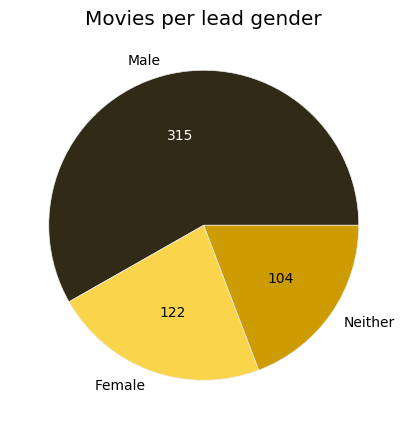
Because we manually labeled lead gender in our dataset, we can vouch for the quality and correctness of those labels. Furthermore, having a third neither category allows for a more nuanced view as well. Figure 1 shows that there is a significant number of movies which do not have a clear female or male lead, and thus fall into the category of neither.
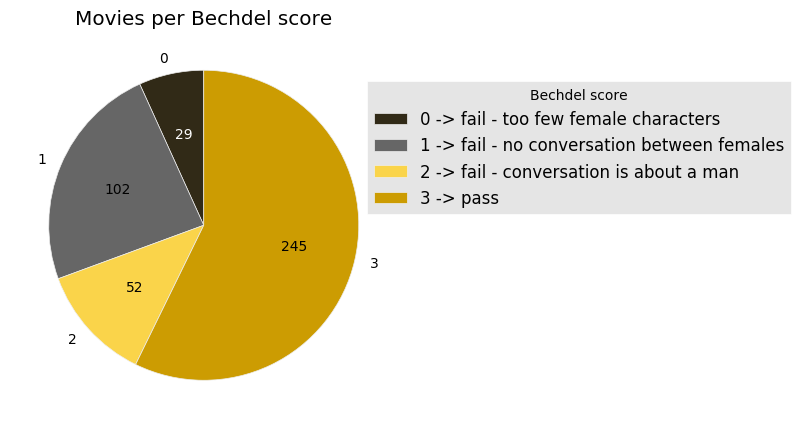
We also labeled our data with Bechdel test scores. The Bechdel test is a very simple measure of the representation of women, and passes for movies which have at least one scene in which two women have a conversation with each other about something other than a man. (We’ve had an in depth discussion on the Bechdel test in a previous blog post [5].) Bechdel test results were not manually labeled, but were instead sourced from bechdeltest.com. The distribution of Bechdel test scores can be found in Figure 2.
Box Office By Gender
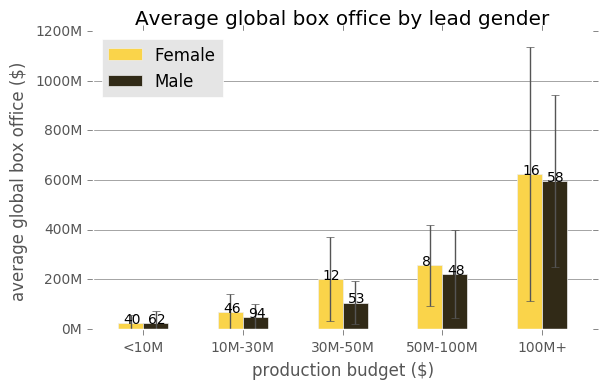
How does lead gender influence a movie’s box office performance? We investigated the difference in global box office earnings between male- and female-led movies. The result can be seen in Figure 3, which compares the average global box office between the two lead genders, for different production budget ranges. Although the averages for female-led movies are slightly higher than those for male leads, the differences are too small to conclude that this is the result of some systematic gender-related phenomenon. This is especially true considering the small number of examples for female-led movies and the large spread of box office revenues.
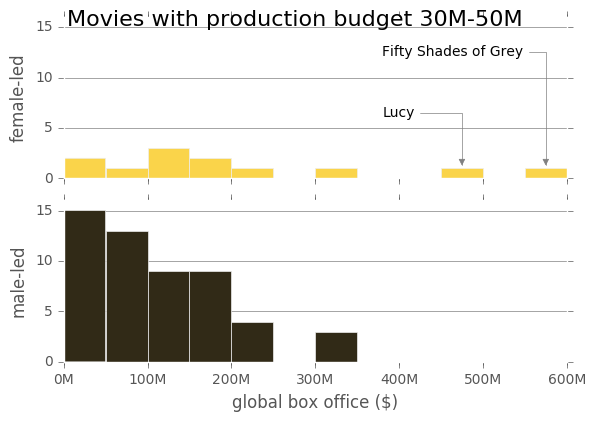
Only for movies with a production budget in the 30–50M range does the difference seem significant enough to warrant a closer look. Figure 4 compares the distributions of global box office revenues for movies that fall into this range. It shows that the large difference between the two averages is not caused by a systematic shift, but is instead entirely due to two female-led high earning titles. Although this data does not contradict the claim that female-led movies are more successful, two data points are too few to draw conclusions from with any degree of certainty.
Given the outcome of our analysis, we cannot confirm the findings of the shift7 study which claims female-led movies perform significantly better at the box office than male-led movies. Instead, our findings show that box office revenues of male-led and female-led movies are quite similar, and that any observed differences are largely caused by the presence of just a few outliers.
While our data neither proves nor rejects the claim that having a female lead has a positive effect on box office, we can reject the somewhat old-fashioned belief that it is better to have a male lead.
If anything, the only conclusion that can be drawn is that the influence of lead gender on the box office is probably non-existent, and most likely minimal at best.
Bechdel Test
If the lead gender has no obvious relation to box office, then what about the representation of women in general? Despite its obvious flaws, the industry standard metric for this is still the Bechdel test. We compare the box office revenue of movies that pass the Bechdel test to those that don’t in Figure 5. At first glance, the plot suggests that films that pass the Bechdel test outperform those that do not, but the error margins demand a more nuanced explanation.
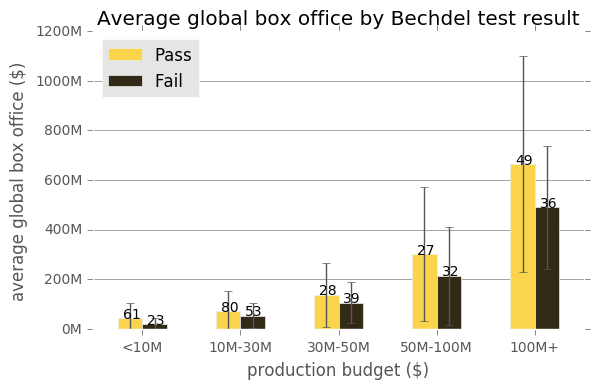
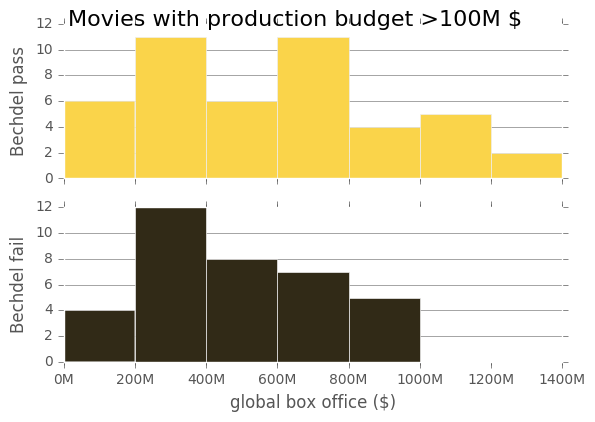
Figure 6 provides a more detailed comparison of the box office results for movies with a production budget of over 100M $. It suggests that the top grossing movies consistently pass the Bechdel test. However, disregarding those movies, there are no other substantial differences between the two distributions.
We should also note that, while the top grossing movies pass the Bechdel test, they do not always do so because of their exemplary representation of women. For example, Transformers: Age of Extinction barely passes the test, and can by no means be considered a good role model regarding sexism [6]. Another example is Rogue One: A Star Wars Story: while its lead character is female, nearly all of the other active characters are male. The movie technically passes the test, but with the narrowest margin possible.
This leads us to question whether a movie’s Bechdel test results really influence its box office, or whether it’s the other way around, namely, that writers of large blockbuster movies take care to add the required scene simply to pass (read: fool) the test. All we can do is observe that there does seem to be a correlation between the two, but addressing whether there is any causality involved is a different issue altogether, and out of the scope of this study.
Presence of Women in Movies
While we can’t support the claim that having a female lead will have a positive effect on a movie’s revenue, at least both our and CAA / shift7’s study can conclude that the reverse is certainly not true either. Nevertheless, even today, we still see a large disparity between the number of female and male leads in movies, and between the number of female and male roles in general [7].
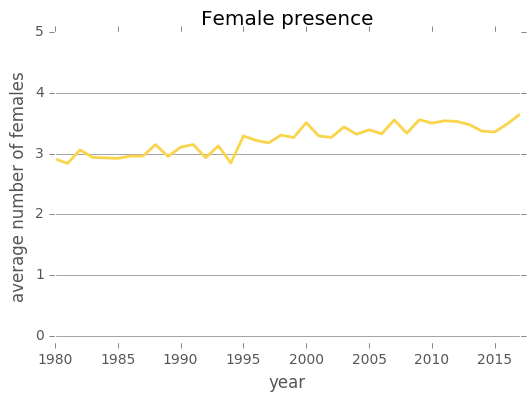
We took a look at the number of females among the top ten actors, based on IMDb’s ranking, for each movie. Figure 7 shows the evolution of this number throughout the years. As can be seen in the figure, the movie industry still has some ground to cover before reaching gender equality. However, it is reassuring to see that we are slowly but surely making progress towards that goal.
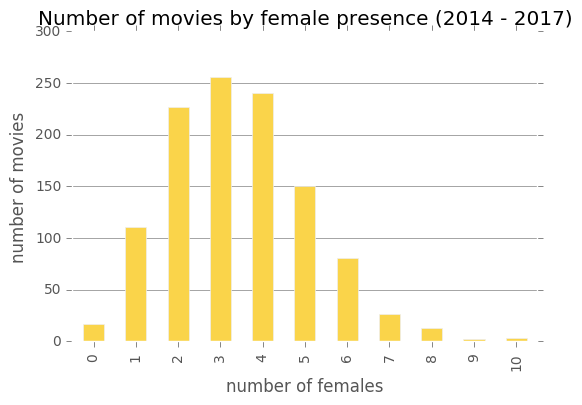
To further investigate the rather low presence of females in movies, we zoomed in on the distribution of female presence in movies in recent years. Figure 8 shows how lopsided this distribution is. Especially noteworthy is the extremely low number of female-dominated movies, compared to the plethora of male-dominated ones. In our dataset we have 355 movies with eight or more males in the top cast, compared to just 18 movies with at least eight females in the top cast.
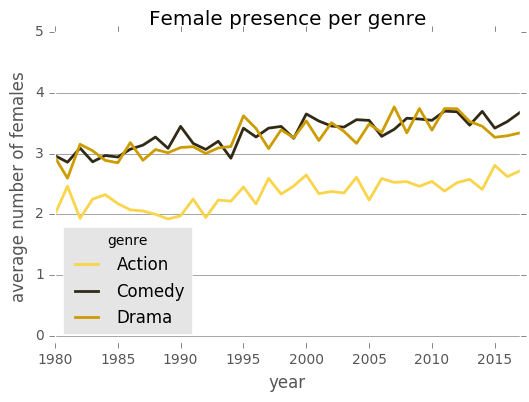
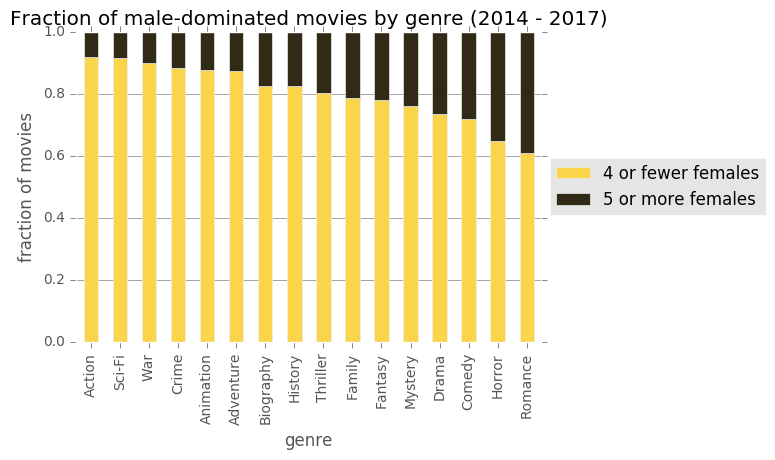
Finally, we also looked at the distribution and evolution of the number of females for individual genres. Figure 9 shows the average number of female cast members in the top ten for movie genres action, comedy and drama throughout the years. First of all, we observe that the slow but steady trend towards gender equality applies to each of the individual genres too. That being said, we do notice a large disparity in the average number of female cast members between individual film genres. Figure 10 visualises this disparity for all genres we considered. While none of the genres have a healthy male-female balance, the worst offenders are action, sci-fi and war movies. The romance, horror, comedy and drama genres have the most women in their cast.
Conclusion
At ScriptBook, we were sparked by the significant media coverage for a study claiming female-led movies do better at the box office. In order to obtain a more nuanced view on the matter, we decided to do an in-depth study of our own. Using our own data set, we investigated the link between lead gender and box office revenue, between Bechdel test results and box office revenue, and also shortly discussed the still-enormous male dominance on the film set.
Our results show that:
- the data does not support the claim that female-led movies do better at the box office, but neither do male-led ones.
- the top-grossing movies consistently pass the Bechdel test, but we cannot exclude the possibility of this being the result of writers trying to simply fool the test.
- we still have a long way to go to reach gender equality in movies, but are making slow but steady progress towards that goal.
These conclusions might lack the strong and flashy statements that generate a lot of attention in the popular media, but at ScriptBook, we take pride in our nuanced views that are truthful to the data. It is well known that you can show anything with statistics, and it would be easy for us to simply forego the error bars and detailed views in our figures, consequently ignoring the fact that any observed differences are caused by less than a handful of data points.
Even though we cannot conclude that women bring in more box office revenue, we can reject the opposite claim as well. This means that there is no reason not to cast more women, either in lead roles or supporting roles. We noticed that the presence of females in movies has been steadily rising through the years, but it is a slow process. Women are still underrepresented, but hopefully the success of recent movies with prominent female leads such as “Wonder Woman” and “Captain Marvel” lead to an accelerated pace towards gender equality in the near future.
References
- Films with female stars earn more at the box office (2018, December 12). Retrieved from https://www.bbc.com/news/business-46539473
- McNary, D. (2018, December 11). Movies Starring Women Outperform Male-Led Titles at Box Office, Study Finds. Retrieved from Variety
- Delbyck, C. (2018, December 11). Movies Starring Women Make More Money At The Box Office, Study Finds. Retrieved from HuffPost
- shift7 (n.d.). Female-led films outperform at box office for 2014–2017. Retrieved from shift7.com/media-research
- ScriptBook (2017, November 24). ScriptBook’s artificial intelligent gender measure confirms gender inequality in film. Retrieved from local article
- Acuna, K. (2014, June 30). The Most Annoying Thing About ‘Transformers’ Is Michael Bay’s Fixation On Objectifying Women. Retrieved from Business Insider
- Lauzen, M. (2019). It’s a Man’s (Celluloid) World: Portrayals of Female Characters in the Top Grossing Films of 2018. Retrieved from SDSU Women in Film