A declining cinema-going population and increasing competition from Netflix & video-on-demand services are making it harder to monetize audience attention [1, 2] from the silver screen. One of the most bemoaned consequences is the wane of original content in big productions [3, 4].
One could argue that from a risk mitigation point of view, large studios would rather invest in a film project that was commercially successful before, like an established franchise or films based on popular IP, than creating truly novel, but risky stories.
In this blogpost we will explain how AI can be used as an ally in the quest for original content while maximizing profitability. The public assumptions and criticisms under scrutiny go as follows:
- If algorithms get to decide which scripts will be produced, then why would they not exclusively allocate resources to derivative, formulaic blockbuster vehicles from successful franchises such as “The Avengers”, “Transformers”, “Star Wars”, etc.?
- Wouldn’t it simply extrapolate from the data that such films provide the largest gain for the least amount of risk?
- Even worse — If algorithms are trained on previous films, how would they be able to see the appeal of truly innovative content, such as “Memento”, “Inside Out”, “District 9”, “Being John Malkovich”, etc.
The fear that AI will only aggravate the trend towards tentpoles — is different in nature, but touches on a similar subject as our previous blog post [5]: to what extent is an AI capable of casting judgment upon human creative works?
At ScriptBook, our system is not tuned towards detecting originality for the sake of detecting originality. This being said, the public assumption goes that because we attempt to model profit, original content will no longer get any chance because it will be overpowered by the blockbusters.
We believe that this criticism is rather the consequence of confirmation bias. For one thing, the tentpoles undeniably make the most noise marketing wise, so much so that sometimes it can obscure the fact that other movies still get made as well. One simply has to look at all the ink spilled over the record breaking opening weekend of “Avengers: Infinity Wars” as a recent example of this. But the ever growing success and importance of film festivals like Sundance [6] and the ongoing recognition of festivals like Berlinale do prove that so-called smaller movies are still very much in demand.
For another, the sheer size of the numbers involved with blockbusters somewhat obscures the fact that they are not necessarily that profitable, relatively speaking. The eighth installment in the “Fast and Furious” franchise, “The Fate of the Furious”, brought in over $1B worldwide at the box office, but costs $250M to make [7]. Following the industry adage that marketing spent (easily for this type of movie) equals production budget, the movie would have only won back its costs once. Keep in mind that we consider box office earnings only, and do not take other revenue streams into account. Financially speaking it might be a relatively safe investment, but not necessarily the most interesting one.
Conversely, far more low budget than big budget movies get made, making their chance to succeed and stand out from the crowd slimmer. But when they do stand out, they present tremendous opportunity for profit. For example, this year’s unexpected hit “A Quiet Place”, which was made with a relatively modest budget of $17M had already brought in nearly $163M worldwide after being released for a mere 10 days [8]. 2017’s acclaimed “Get Out” was made on a $5M budget and has made approximately $255M [9], more than 50 times its production budget.
With the following, ScriptBook will not only disprove the idea that an AI predicting profitability is incapable of greenlighting smaller movies, but also demonstrate that it performs better than humans when it comes to selecting interesting investment opportunities.
Use case 1
For our first experiment, consider the following list of the top 10 most absolute profitable movies from our database, released after 2000, as predicted by ScriptBook, based solely on their script.
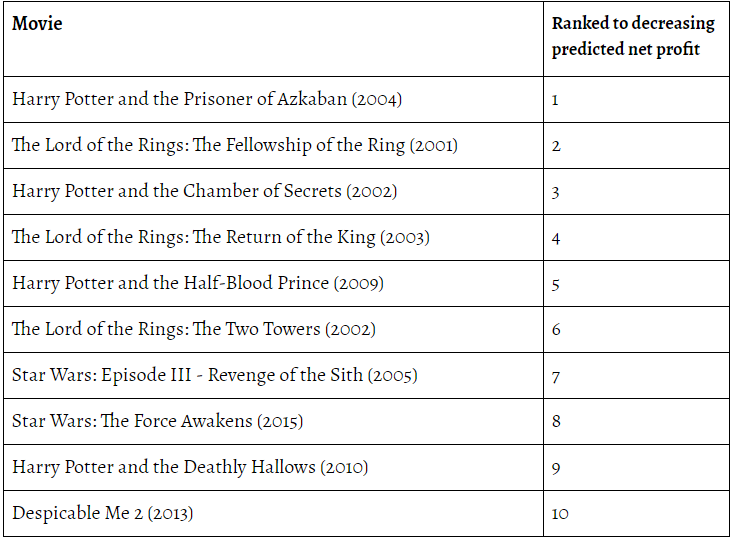
When we look at our data and in a first instance focus on absolute profit, we predict the “usual suspects”. We do indeed completely follow the “established big blockbuster” trend. All movies in this list are either sequels, or in the case of the first “Lord of the Rings”, based on highly successful IP.
Things become more interesting however if instead of focusing on absolute profit we turn to a relative metric like “return on investment” or ROI.
ROI = net profit / production budget
That is to say, the net profit is defined as what remains of the worldwide gross (worldwide box office) after taking into account the total production budget.
Use case 2
For our second experiment, we selected a representative dataset of movies released between 2000 and 2015 with a production budget of less than $10M (low-budget). We then ranked these movies according to decreasing ROI, as predicted by ScriptBook, based solely on their script, and we checked how well the top x% of movies in this list performed compared to the total set. The main point we wish to verify here is whether ScriptBook would greenlight movies that are generally considered to be rather “low scale”, i.e., exactly those type of movies that the aforementioned criticism fears AI would never greenlight because of a lack of profitability.
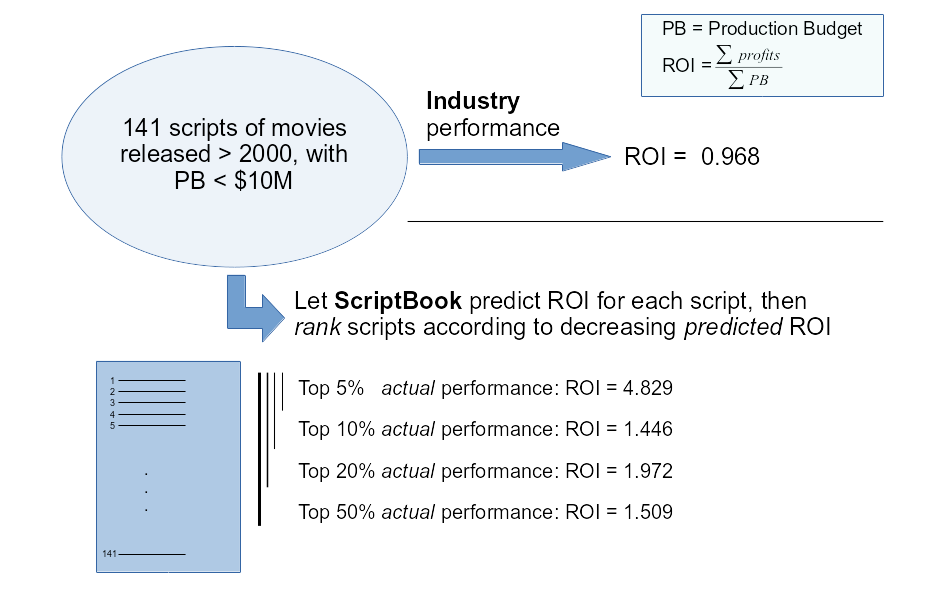
The (estimated) real-life ROI over the complete list described above is 0.968. This number should be read as “if one sums up all made profits/losses for these movies and divides this by the sum of all production costs, the total net profit would be 0.968 times the total production costs”.
To compare this against ScriptBook’s performance, consider Figure 1 (below), in which we depict our experiment graphically, along with how the subset of top x% movies in this list have performed, according to the same definition used above.
What does this figure tell you?
It tells you that over the selection of films the industry has chosen to make, our algorithms clearly manage to pick out the more profitable ones.
If you were a studio, production company, investor or a film fund, and would have financed or produced the top 5% of scripts from your portfolio as predicted by ScriptBook, you would have won back 4.829 times the total production cost, far superior to the industry average of 0.968. Expanding the list to the top 20%, ScriptBook would still beat the industry with a factor 2.
The kicker is that the top 5% of movies contains, e.g., critical hit “A Separation” and “Fruitvale Station”. Extending to the top 10% sees the additional inclusion of, a.o., “Safety Not Guaranteed” and “The Sessions”, and extending further to the top 20% would even see the inclusion of movies such as Blue Valentine (2011) and even the low-key yet Oscar-winning, award magnet and critical arthouse darling Amour (2012).
Conclusion
These experiments prove that our algorithms are perfectly capable of greenlighting smaller, independent creative movies. Not only that, but given a selection of movies, on average they manage to pick out the profitable ones far better than the industry.
Perhaps even more important though is the general conclusion that a lot of original movies are still being made, and moreover, they can also be profitable. Again, looking at recent examples such as ‘Get Out’ and ‘A Quiet Place’, quality is, luckily, ultimately rewarded.
Making a profit does not necessarily imply raking in millions of dollars; not every movie out there is released with the intention to smash box office records. But at the end of the day, costs need to be recouped and audience attention needs to be monetized. Making movies is expensive, and investing in a movie still is a risky (ad)venture, and just like any business, stakeholders look for ways to assess those risks. This does not automatically mean pitting a film like ‘Amour’ against the latest ‘Fast and Furious’. It might very well mean making a difficult choice between two original low budget movies.
References
- the-numbers.com/market/
- Bloomberg: Hollywood’s 2017 is a Bomb as Moviegoing Slumps to 25-Year Low
- GeekTyrant: The Decline of Original Movies Infographic
- the-numbers.com/market/sources
- Artificial Intelligence and the myth of it killing creativity
- Deseret News: Sundance 17 Sets Records
- Box Office Mojo — The Fate of the Furious, accessed 26 April 2018
- Box Office Mojo — A Quiet Place, accessed 26 April 2018
- Box Office Mojo — Get Out, accessed 26 April 2018